


Future Now: The Defining Tech Gadgets of 2026
Welcome to 2026. The speculative press releases of the early 2020s have finally materialized into devices that fundamentally alter how we interact with the digital world. This year isn’t about incremental upgrades; it’s about synthesis—the moment Artificial Intelligence, material science, and high-speed connectivity seamlessly merged.
We’ve curated the absolute best-in-class gadgets that define this era. These aren’t just tools; they are extensions of our digital selves.
1. The Neuralink ‘Kenshō’ Smart Glasses
Forget the bulky headsets of the past. The defining wearable of 2026 is the Neuralink Kenshō. This isn’t just augmented reality; it’s practically mediated reality.
The Kenshō glasses are lightweight, resembling high-end fashion eyewear rather than a tech product. They feature the first true retinal projection system, painting light directly onto your eyes, allowing digital objects to coexist perfectly with the physical world.
They don’t require awkward hand gestures. A subtle neural interface (a small, discreet node behind the ear) interprets intentional thought patterns. You can scroll, select, and communicate simply by thinking about the action.

(Image 1: The Neuralink Kenshō in action, displaying an ambient data overlay of the wearer’s surroundings as dusk falls. The form factor is indistinguishable from classic luxury glasses.)
Why it’s a Game Changer: The Kenshō makes the smartphone obsolete by integrating navigation, translation, and communication directly into your field of vision, all controlled by thought. It is the ultimate invisible interface.
2. The Samsung ‘Morph’ Rollable Tablet
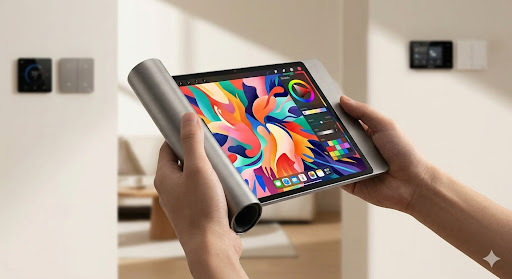
The ‘foldable’ wars of the early 20s ended when material science gifted us with true rolling displays. The Samsung Morph is the pinnacle of this evolution: a device that defies rigid definitions.
When stowed, the Morph is a dense, elegant brushed titanium baton, easily fitting in a jacket pocket. But with a smooth, motorized whisper, it unrolls into a stunning, seamless 13-inch OLED display. It uses a new type of shape-memory alloy that provides rigid structure when fully extended, eliminating the ‘flop’ factor of early prototypes.
This device adapts to you. Need a simple e-reader? Unroll it halfway. Need a full canvas for design work or a sprawling workspace? Extend it fully.
(Image 2: The Samsung Morph rollable tablet, unrolled to 70% to display a digital art canvas. The device maintains the minimalist, metallic design signature established this year.)
Why it’s a Game Changer: It provides a 13-inch screen experience in a form factor smaller than a traditional smartphone. It’s the ultimate adaptive workspace, perfect for the nomadic professional.
3. The Tesla ‘Aegis’ Personal Sentry Drone
In 2026, personal security is proactive, intelligent, and autonomous. The Tesla Aegis is not a toy camera drone; it is a sophisticated, palm-sized guardian designed for situational awareness.
The Aegis utilizes Tesla’s advanced Autopilot algorithms to operate completely hands-free. When activated, it launches silently from its sleek charging case and flies a pre-programmed or AI-determined boundary layer around the user. It uses high-definition LiDAR and thermal imaging to map environments and identify potential hazards—from slick pavement to unseen obstacles or approaching individuals.
Its most impressive feature is ‘Sentry Mode Live,’ which streams an encrypted, high-definition holographic feed directly to the user’s smart glasses (like the Kenshō), providing a 360-degree, top-down perspective of their surroundings in real-time.
(Image 3: The Tesla Aegis hovering silently above a desk. Its matte spherical design is propellor-free, using silent ionic propulsion that emits a faint blue glow. The form language is unified with the high-tech, minimal aesthetic.)
Why it’s a Game Changer: The Aegis moves drone technology from recreation to essential utility. It provides a level of non-invasive, autonomous situational awareness that was previously restricted to military applications.